How to Set Up a Carp Rod: A Beginner's Walkthrough

As an Amazon Associate we earn from qualifying purchases. This page contains affiliate links — if you buy through them, we earn a small commission at no extra cost to you.
You’ve spent £45–£80 on a rod-and-reel combo and now you’re staring at a box of bits. Which one goes where? The good news is you don’t need a degree in engineering or a night spent trawling forums. A simple rig, fitted right, catches carp on most UK day-ticket waters. You can have it ready before your tea goes cold.
What You Actually Need (and What You Don’t)
For most English and Welsh club waters, a starter kit is surprisingly simple. Here’s what matters.
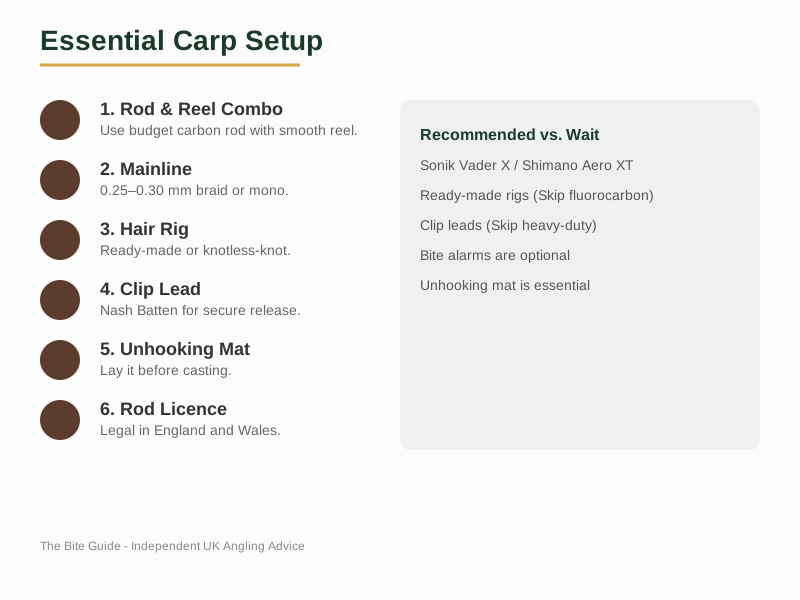
You need:
- Rod and reel combo: An entry-level carbon rod paired with a smooth-winding reel. The Sonik Vader X (paid link) rod is a frequent favourite on forums for its value. For the reel, a Shimano Baitrunner XT (paid link) is a solid choice if your budget allows, otherwise a reliable model from a high-street range works fine.
See Sonik Vader X on Amazon → (paid link)
- Mainline: 0.25–0.30 mm braid or monofilament. Braid gives you the casting distance most beginners need; monofilament is a bit kinder when you’re tying your first knots.
- Hooklink: A ready-made hair rig or a simple knotless-knot hair rig. The latter is the “set-and-forget” choice that UK anglers swear by.
- Lead: A clip lead. The Nash Heavy Duty Lead Clip (paid link) is often praised for its click-fit security.
Find Nash Heavy Duty Lead Clip on Amazon → (paid link)
- Unhooking mat: This is essential. The Angling Trust lists it as a core fish-care item.
- EA rod licence: A legal must for any coarse fishing in England and Wales.
You can skip for now:
- Bite alarms & buzzer bars: Handy for night sessions, but not essential for a daytime start.
- Heavy-duty leads: A basic 1–2 oz clip lead does the job without drama.
- Specialist hooks: A standard Korda Rig Ring on a size 6 hook works on most gravel pits. You don’t need the premium Dark Matter version yet.
- High-tech rods: Models like the Fox Horizon X (paid link) are overkill for a first season. Their price and need to match the blank to your casting style add complexity you don’t need.
View Fox Horizon X price on Amazon → (paid link)
The honest answer is that a typical £45–£80 starter combo is about 90% as effective as a £200 pro kit on a day-ticket water. Buy the cheap ready-made rig, fit a clip lead, and you’ll be catching.
Download the Free Beginner Carp Fishing Checklist to double-check every item before you head out.
Attaching the Reel to the Rod
First, mount the reel securely. Most starter rods have a simple tube-type reel seat on the butt section.
- Locate the seat. It’s usually a hollow cylinder with a small screw or lever on the side.
- Slide the reel foot in. Align the foot with the seat’s groove; it should sit flush without forcing.
- Tighten the clamp. Use a flat-head screwdriver or a coin – never your teeth. Turn it just enough that the reel doesn’t wobble when you give the handle a light pull.
- Check for play. Hold the rod by the handle and shake the reel. Any side-to-side movement means the clamp isn’t tight enough.
- Avoid overtightening. This can strip the threads on the rod butt, a fault many beginners only discover after a costly repair.
A common mistake reported on forums is a reel clamped too tight, which can strain the seat and lead to line twist. The fix is simple: back the screw out a half-turn and re-test.
For specific rod recommendations, see our guide to the best carp rods for beginners.
Threading the Mainline
This is where most of the faff happens, but a couple of tricks make it straightforward.
Start at the tip. The smallest eye at the very end of the rod is your entry point. Work backwards, pulling the line gently through each guide toward the butt.
A good trick is to use a short piece of kitchen-grade silicone tubing (about 5 cm) slipped over the line tip. It acts as a tiny funnel, stopping the line from catching on the guide’s edge. Don’t force it. If you feel resistance, stop – forcing can fray the line and weaken it.
Once the line reaches the reel seat, leave a small loop (about the size of a £1 coin). This loop is where you’ll attach the reel.
A frequent error spotted on UK carp forums is the “tight-rope” line: pulling the line taut through the guides creates a permanent kink that can snap later. Keep the line slightly loose while threading, and only tighten it after the reel is attached.
For reel-specific advice, our best carp reels for beginners page breaks down the features you actually need.
Attaching the Hooklink and Lead
This is the heart of the rig – the hooklink (usually a hair rig) and the lead that keeps the bait down.
- Tie or fit the hooklink. Most beginners use a ready-made hair rig; just slide it onto the mainline loop at the butt. If you’re tying, the knotless-knot (six to eight turns, wet the knot before tightening) is the go-to on UK waters.
- Add the lead clip. Clip a Nash Heavy Duty Lead Clip (paid link) lead clip onto the hair’s loop. The click-fit design consistently gets praise for preventing the lead from slipping when a carp lifts the bait.
- Attach the lead. Slip a 1–2 oz lead onto the clip. The clip’s spring tension holds it securely but will release under a strong pull, protecting the hooklink from breaking.
- Check the weight. Make sure the lead isn’t heavier than the rod’s rating (most starter rods handle up to 2 oz). Over-loading hurts casting distance and can stress the reel clutch.
- Test the rig. Give the line a gentle tug; the lead should stay put, and the hooklink should swivel freely.
Why a clip lead matters: Anglers on silty club waters report that a direct knot between lead and hair often results in the lead being “eaten” as the carp moves. The clip’s quick-release action stops that loss.
For other rig options, the best carp rigs for beginners article covers the helicopter and chod rig, and why the simple hair-clip combo is spot on for most UK venues.
Setting Up Bite Alarms (Optional)
Think of bite alarms as a night-time coffee kick – handy, but not mandatory for a first season.
- Mount the alarm. Clip it onto a rod pod or a sturdy bankstick.
- Run the leads. Connect the alarm’s lead to the rod’s bite-alarm jack; many starter reels have a dedicated socket.
- Adjust sensitivity. Start low. A high setting will trigger on wind or water movement, giving you a false-alarm frenzy.
- Test before casting. Pull the line sharply; the alarm should click once and stay silent until the line is released.
UK forum regulars find that beginners who skip bite alarms still land plenty of fish, but they might miss subtle night bites. If you plan to fish after dark, a basic alarm set is worth the peace of mind.
Preparing for the Session (Fish Care and Venue Reality)
A working rig is only half the battle. How you handle the fish and respect the venue makes or breaks your day.
- Unhooking mat ready. Lay the mat on the bank before you cast. The Angling Trust recommends its use, and most club waters include it in their rules — check the fishery’s bylaws before you go.
- Check venue rules. Every day-ticket fishery has its own by-laws: some limit lead weight, others require a specific hook size. Ignoring them gets you kicked off.
- Weed and snag awareness. On a weedy lake, a simple hair rig with a clip lead is far more reliable than a complex chod rig, which can snag. On silty water, a short hair (about 25 mm) keeps the bait off the mud.
- Fish-care steps. When you land a carp, keep it in the water as long as possible, use the unhooking mat, and avoid yanking it out. The Angling Trust advises wet hands and a quick release.
- Positioning on the bank. Don’t cast too close to other anglers; a 2-metre buffer prevents line-crosses and keeps your bite alarm clear.
The “forgot-the-mat” mistake is the most common cause of a fish being released badly. A quick glance in your tackle bag before you leave home eliminates that faff.
Starter Carp Rod Setup Checklist
| Item | Recommended | Skip for Now |
|---|---|---|
| Rod | Sonik Vader X (paid link) | Fox Horizon X (paid link) |
| Reel | Shimano Baitrunner XT (paid link) (or a reliable budget model) | Premium specialist models |
| Mainline | 0.25–0.30 mm braid or mono | Fluorocarbon |
| Hooklink | Ready-made hair rig or knotless-knot | Specialist hooks like Korda Dark Matter (paid link) |
| Lead | Clip lead (Nash Heavy Duty Lead Clip (paid link)) | Heavy-duty or inline leads |
| Bite Alarm | Optional | Buzzer bar |
| Unhooking Mat | Essential | — |
| Rod Pod | Only if windy or using banksticks | — |
Frequently Asked Questions
Do I really need a rod licence?
Yes. An Environment Agency rod licence is a legal requirement for all coarse fishing in England and Wales. A one-rod annual licence costs around £30; a one-day, two-rod licence is around £6. You can buy either directly through the EA website . Fishing without one risks a fine, whether you’re on a club water, day-ticket lake, or river.
What is the best rig for a beginner?
A simple hair rig with a clip lead is the most reliable choice on typical UK day-ticket waters. It’s cheap, easy to set up, and the clip prevents lead loss. Forum regulars on silty, weedy, and gravel pits all report higher success with this setup than with complex rigs like the chod or helicopter – especially for first-timers.
Can I use a spinning rod for carp fishing?
No. Carp rods are built to handle heavy leads and strong hooklinks. A spinning rod’s line-release system can’t cope with the sudden pull of a 2 oz lead, and the risk of a broken reel or snapped blank is high. You’ll also lose control during the fight. Stick to a dedicated carp rod – even a budget one.
How do I know if my reel is spooled correctly?
The line should sit tight and even on the spool, with no gaps or overlapping loops. If you see loose sections, rewind the line, keeping tension steady. A good trick: hold the spool between your fingers and spin the reel handle slowly – if the line jumps or winds unevenly, start over.
What should I do if my line keeps twisting?
First, check that the reel is spooled correctly – a loose start creates twist. Second, make sure the reel clamp isn’t overtightened. If the problem persists, a short length of braid (1–2 metres) ahead of the mainline can act as a twist-breaker. It’s not magic, but it works.
Where do I find my local venue’s by-laws?
Most day-ticket fisheries list them on their website, or you can ask at the tackle shop or office when you pay your fee. The Environment Agency doesn’t set venue rules – the fishery does. Pay attention to hook size limits, banned baits, or mandatory lead weights.
You now have a clear picture of the minimum gear, the steps to assemble it, and the fish-care habits that keep you on the right side of the law. The honest answer is you don’t need a £200 rig to start catching carp – a well-set up £50–£80 combo does the job on most day-ticket lakes.
Ready to make sure nothing’s missing? Download the Free Beginner Carp Fishing Checklist for a quick, printable reference that covers every bit we’ve discussed.
Remember – the simplest rig is often the most effective.
About The Bite Guide Team | Contact Us | Browse the Blog
For more questions answered, see the Carp Rod Setup Q&A Hub .
Explore More Topics
Go deeper on specific topics:
- Carp Rod Test Curve Explained: What Does It Mean for You?
- Mainline and Leader Choice for Carp Fishing (By Venue Type)
- Carp Hooks Explained: Patterns, Sizes and Sharpness
As an Amazon Associate we earn from qualifying purchases.