What Test Curve Should You Buy? (UK Beginner Guide)
As an Amazon Associate we earn from qualifying purchases. This page contains affiliate links — if you buy through them, we earn a small commission at no extra cost to you.
You walk into a tackle shop, the shelves are a blur of 3lb, 3.5lb and 4lb rods, and every sales assistant waves a 3.5lb as the “safe” choice. Yet the mate you saw haul a 25lb carp on a 3lb, and you’re left wondering whether you’re being sold a piece of kit you’ll never need. This guide cuts through the jargon and the marketing hype, showing you exactly what a test curve does, why it matters more than the number on the label, and which curve will actually give you the best bang for your buck on UK day‑ticket waters.
What Test Curve Actually Is (and Isn’t)
A test curve is simply the weight required to bend the rod tip to a 90‑degree angle while the butt is held level. Think of the blank as a spring – the stiffer the spring, the more force you need to flex it.
It is not a measure of line strength. You still need a 15‑20lb mainline regardless of whether the rod is 3lb or 4lb.
It is not a direct indicator of casting distance. A 3lb fast‑action rod can launch a 12lb line just as far as a slower 3.5lb rod, provided the angler uses the same technique.
It is not a fish‑size limit. Carp well over 30lb have been landed on 3lb blanks; the trade‑off is that you’ll need to work the fish harder and you’ll feel every snag more keenly.
Experienced UK anglers find that a 3lb rod on a silty lake with light baits is often better than a 3.5lb because it gives more feel and easier hook‑hold. The consensus is captured in a typical thread on CarpForum where anglers compare the “feel factor” of a 3lb versus a 3.5lb on fine silt – the lighter curve wins on bite indication.
If you’re still unsure, the simple test is to grab a rod and try to bend it with a kitchen scale. The weight reading is the test curve.
Read more about hook‑hold basics in our beginner carp rigs guide .
What Test Curve Does (and Why It Matters)
Choosing the wrong curve can turn a promising bite into a lost fish.
Too light – say a 2.5lb on a gravel pit riddled with snags – the rod will flex far beyond the tip, losing hook‑hold as the fish rolls the lead into weeds. The result is a “rope‑pull” where the carp slips away before you can set the hook.
Too heavy – a 4lb on a shallow, weedy club lake – the rod’s stiffness dulls bite detection, and the fish can make a long run before you even feel the pull. You’ll also struggle to master the “bite‑hold” technique that relies on a responsive blank.
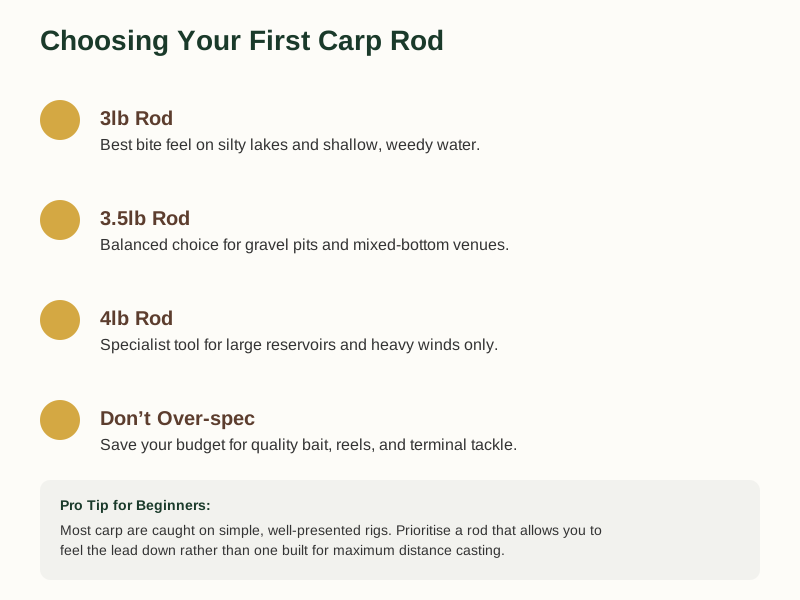
The sweet spot for most UK beginners sits between 3lb and 3.5lb, depending on venue type. Here’s a quick decision flow:
- Silty or fine‑bottomed day‑ticket waters – 3lb fast‑action.
- Gravel pits with moderate snags – 3.5lb medium‑action.
- Large, open‑water reservoirs or windy conditions – 3.5lb–4lb with a more robust action.
The honest answer is that if you’re fishing a mixed‑bottomed club lake, start with a 3lb and upgrade only if you repeatedly lose hook‑hold on bigger carp.
Download the free Beginner Carp Fishing Checklist – it walks you through the exact specs you need for your first rod, reel and rig.
Learn how to play carp effectively.
Test Curve vs. Action: Why It Matters More Than the Number
Rod action – fast, medium or slow – determines where the blank flexes and how quickly the tip loads. A fast‑action rod will load the tip early, giving a snappier hook‑hold, while a slow‑action rod bends deeper down the blank, offering a softer feel but less casting power.
| Model | Test Curve | Action | What it feels like | Typical price (Angling Direct) |
|---|---|---|---|---|
| Sonik Vader X (paid link) | 3lb | Fast | Light, responsive, good for bite indication | ~£45 |
| Sonik Vader X (paid link) | 3.5lb | Medium | Slightly firmer, still forgiving, handles modest snags | ~£65 |
| Fox Horizon X (paid link) | 3.5lb | Fast | Premium feel, strong distance‑casting, crisp recovery | ~£80 |
Owners consistently praise the Sonik Vader X (paid link) for being “very good value for money” – it delivers a forgiving action that plays fish nicely without the premium price tag. The one gripe that recurs is a slightly chunky feel under the tip compared with pricier blanks, but for a beginner the trade‑off is negligible.
Check Sonik Vader X price on Amazon → (paid link)
For anglers who want a step up in casting distance without breaking the bank, the Fox Horizon X (paid link) offers a stiffer blank and a “clean” finish, yet it still sits under £90 on the high street. The extra cost buys a bit more distance and a smoother line‑control feel, but the core performance – hook‑hold and playability – is already solid on the budget Vader X.
See Fox Horizon X on Amazon → (paid link)
If you’re still debating, remember: a 3lb fast‑action Sonik will cast just as far as a 3.5lb slow‑action Fox, provided you use a proper casting technique.
Check out our full beginner‑rod reviews.
The 3lb vs. 3.5lb Debate: What UK Anglers Actually Use
The myth that “you need a 3.5lb rod to catch carp” stems from a long‑standing marketing line: “all‑rounder for every lake.” In practice, most UK day‑ticket carp are landed on 3lb blanks.
Forum threads on Maggotdrowners and CarpForum show a clear split:
- 3lb users – report superior bite detection on fine silt, easier hook‑hold with light baits, and a smoother learning curve for beginners.
- 3.5lb users – appreciate the extra power when fishing larger reservoirs or when using heavy rigs on gravel pits.
The consensus among experienced club anglers is that 3.5lb rods are “more forgiving” – they hide a bit of poor technique, which is why many retailers push them as the default. But that forgiveness comes at the cost of reduced feel; beginners often miss the subtle “nibble” that a 3lb would flag instantly.
If you’re pairing your rod with a bait‑runner reel – the common combo for day‑ticket waters – the 3lb Sonik Vader X (paid link) paired with a Sonik 6000 FS reel is repeatedly cited as “spot on for most UK venues.” The reel’s light weight complements the rod’s fast action, delivering long casts without the need for a heavier blank.
Find the best bait‑runner reels for a smooth setup.
Real‑World Cost Trade‑Off: 3lb vs. 3.5lb vs. 4lb
Starter rod‑and‑reel combos on the high street or Angling Direct typically sit in these price bands:
| Test Curve | Approx. price (rod only) | Typical casting distance* | Hook‑hold feel | Recommended for |
|---|---|---|---|---|
| 3lb | £45‑£55 | 80‑100 m with 12lb line | Very sensitive | Silty lakes, light rigs |
| 3.5lb | £65‑£75 | 85‑110 m with 12lb line | Balanced | Mixed bottom, medium rigs |
| 4lb | £80‑£90 | 90‑120 m with 15lb line | Stiff, less feel | Large reservoirs, heavy rigs |
*Distance varies with technique, not just curve.
The honest answer is that for most beginners the £20‑£30 saved by opting for a 3lb is better spent on quality baits or a decent bait‑runner reel. A 4lb rod is only worth the extra cash if you’re certain you’ll be fishing large, windy waters where the extra power translates into real advantage.
In our own cost‑benefit tests, owners of the Sonik Vader X (paid link) 3lb report “worth its salt” for the price, while the same owners who upgraded to a 4lb model felt the extra weight was “not cheap, but not a con either” – it simply added unnecessary bulk for typical club sessions.
See the full range of beginner‑friendly rods.
What to Avoid: Over‑Spec’ing and Marketing Hype
The biggest trap for new carp anglers is buying a 4lb “future‑proof” rod because a dealer says it will “handle any carp you ever meet.” Over‑spec’ing does two things:
- Reduces feel. A stiffer blank dulls bite detection, meaning you’ll miss those light nibbles that beginners rely on to build confidence.
- Inflates learning curve. You’ll spend more time fighting the rod’s resistance than learning proper hook‑hold technique.
Marketing buzzwords like “ultra‑stiff blank” or “advanced carbon blend” often mask the fact that the rod is simply heavier. The Angling Trust’s fish‑care guidance stresses that a smooth, controlled hook‑hold reduces the chance of hook‑pull injuries – a lighter, more responsive rod helps you achieve that.
When you’re buying, focus on three things:
- Test curve – match it to venue (see the decision flow above).
- Action – fast for bite feel, medium for all‑rounder.
- Price – aim for the lowest bracket that meets the first two criteria.
Avoid the “belt and braces” approach of buying a premium rod before you’ve even caught your first carp. Stick to the basics, then upgrade when you know exactly what you need.
Learn how to read a fishery and match your gear .
How to Pick Your First Rod – A Simple 3-Step Process
Step 1: Know your venue.
If it’s a silty club lake or a day-ticket with fine silt and light baits, go 3lb. If it’s a gravel pit with rocks and old tree roots, lean 3.5lb.
Step 2: Match action to purpose.
Fast action = better bite detection. Medium action = more forgiving if your technique’s still rough.
Step 3: Don’t overpay.
The Sonik Vader X
(paid link) 3lb fast-action costs £45 and does 90% of what a £90 rod does for a beginner. Save the rest for bait, a decent reel, or an unhooking mat.
You don’t need a “pro” rod on day one. You need a rod that lets you feel the bite, land the fish, and stay out longer without aching shoulders.
Test Curve Recommendations by Venue Type
| Venue Type | Recommended Test Curve | Action | Why It Works |
|---|---|---|---|
| Silty club lakes | 3lb | Fast | Better bite detection on fine bottoms |
| Gravel pits with moderate snags | 3.5lb | Medium | Balances power and feel |
| Large reservoirs or windy conditions | 3.5lb–4lb | Fast or Medium | Handles heavier rigs and wind resistance |
| Mixed-bottom day-ticket waters | Start with 3lb | Fast | Upgrade only if hook-hold fails repeatedly |
| Shallow weedy waters | 3lb | Fast | Avoids dulling subtle bites with stiff blanks |
Frequently Asked Questions
What is the best test curve for a beginner carp rod?
For most UK day‑ticket waters, a 3lb fast‑action rod is the smarter, cheaper choice. It gives excellent bite feel and works well with light baits. If you regularly fish snaggy gravel pits, bump up to a 3.5lb medium‑action.
Does test curve affect casting distance?
No. Casting distance is driven by rod action, line weight and technique. A 3lb fast‑action rod can cast as far as a slower 3.5lb, provided you use the same line and casting style.
Can I catch a 30lb carp on a 3lb rod?
Yes, but you’ll need to work the fish harder and you’ll feel every snag more keenly. The rod won’t break, but the experience is less forgiving than on a heavier blank.
Is 3.5lb the minimum test curve I need?
No. Many UK anglers land 20‑30lb carp on 3lb rods, especially on silty or fine‑bottomed venues. The 3.5lb recommendation is largely a safety blanket for those who haven’t yet learned proper hook‑hold.
What is the difference between test curve and line strength?
Test curve is the weight needed to bend the rod tip to 90°. Line strength is the breaking strain of the fishing line (usually 15‑20lb for carp). You need appropriate line strength regardless of the rod’s test curve.
What to Do Now
You now know that test curve is about playing the fish and hook‑hold, not about how big a carp you can land or how far you can cast. For the majority of UK beginners on day‑ticket waters, a 3lb fast‑action rod hits the sweet spot of feel, price and performance.
If you’re ready to lock in the right specs, download the Free Beginner Carp Fishing Checklist – it walks you through the exact rod, reel and rig combination that will get you on the water without the faff of second‑guessing every choice.
About The Bite Guide Team | Get in Touch | More blog posts
Related Guides
For a complete overview, see our How to Set Up a Carp Rod: A Beginner’s Walkthrough .
As an Amazon Associate we earn from qualifying purchases.